Showing posts with label tree anatomy. Show all posts

06 June 2016

Connecting Water and Heaven - Tree Post V

The Infinity Tree, the tree bridge, merges water and sky through the realms of Ether.

Or so many origin myths allude.

This tree is the vision. We have the final drawing stage for this iteration, precursor to the painting, and a part of the Tree Bridge series.

I'm showing the final drawing, but also, I have some more conceptual roughs to shed some light on. These additional process sketches came out of the process for the painting, now beginning its fresh life on the studio board.

From the last tree post, IV, here's the rest of the development in rendering the drawing out:


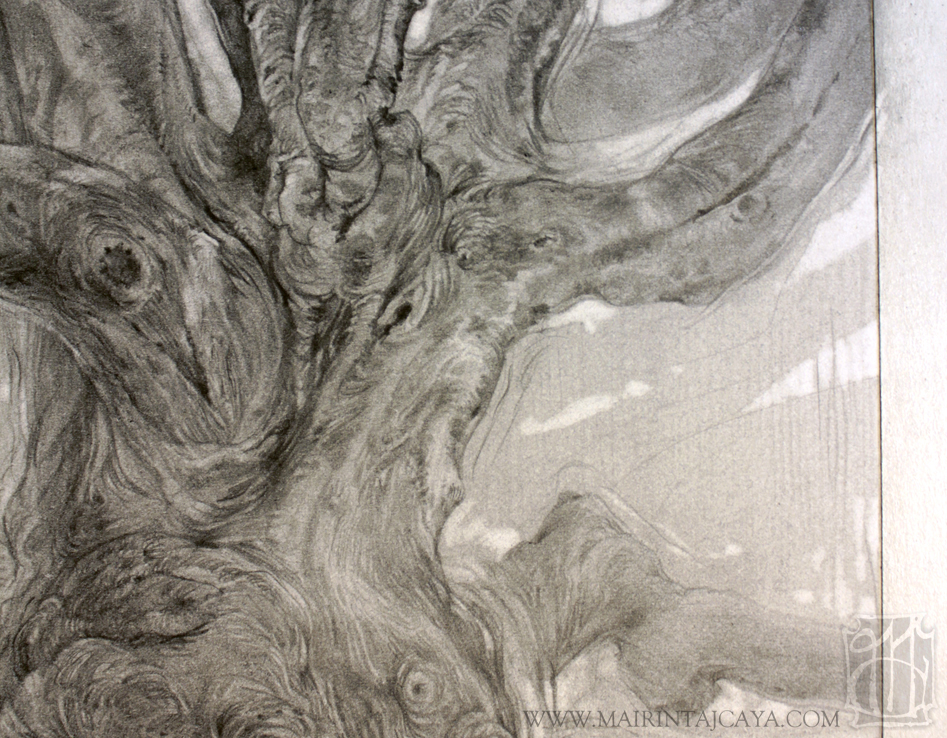
"The Infinity Tree"


Final drawing with graphite and graphite wash on hot press, 10x15".

I do not have this framed yet, as the final drawing frame is a special project in itself. I'm building it out of not-so-standard materials for a unique finish. More for that along with the painting development!

I still need to make full size scans, as well.

Pre-Orders for art prints of the drawing are available now.

Contact me directly for interest here

But then there are those conceptual roughs that I peppered throughout the process of this drawing development.

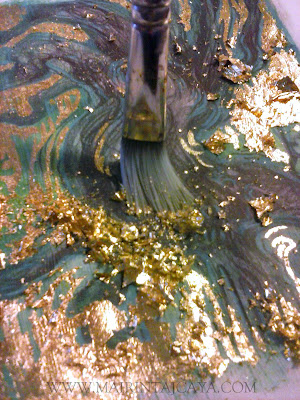
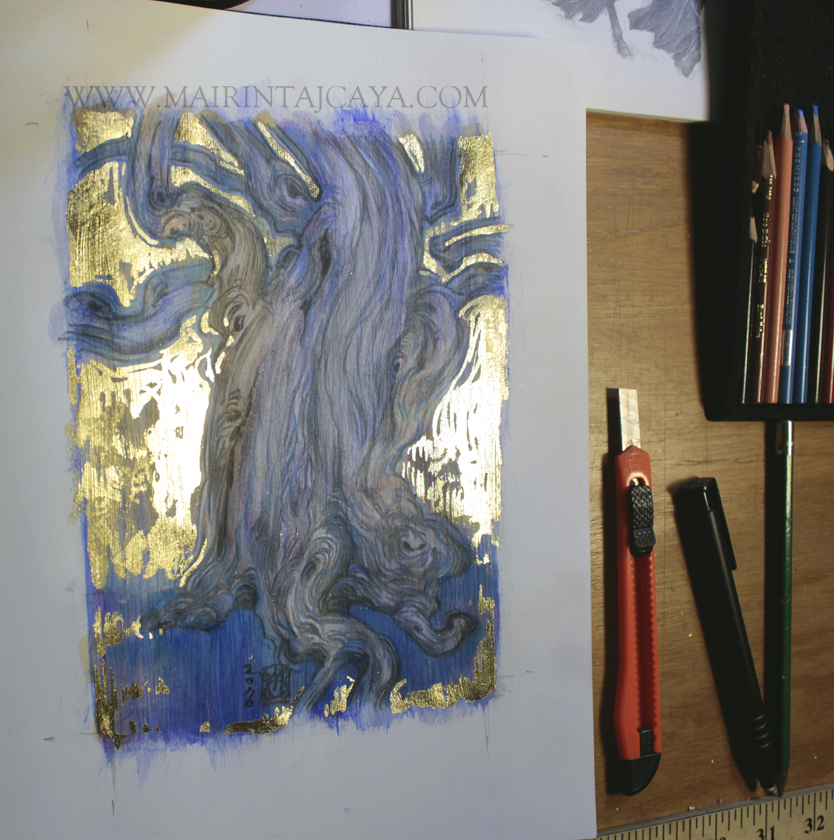
To shake the creative process up a bit, and keep the blood oxygenated nicely along the way, these were done in mixed media on drawing paper, with the tempting gold leaf touch.

Here are some process and detail samples:


Notice, these concept roughs are all not only mixed media, but an abstraction of representational tree form, designed and gestural, each at approximately 5x7".

There will be more on the development in future application of these rough trees.

On to the Infinity Tree painting, for this project!

-Mairin-Taj

18 April 2016

On Drawing Trees & Nature - Tree Post IV

The Infinity Tree continues!
{Review the dialogue for Tree Post I, II, and III here...}

"Harding...fervently believed that nature's beauties are unendingly abundant and infinitely various", writes a contemporary critic - George Landow - of the master and drawing companion to John Ruskin, J. D. Harding.

He passionately advocated for the truth in representational, 'high' art of the natural world, through as unburdened an observation as possible.

Purchase on amazon.com

Harding instructs us to "produce as near a likeness to Nature, in every respect, as the instrument, or material employed, will admit of; not so much by bona fide imitation, as by reviving in the mind those ideas which are awakened by a contemplation of Nature.... The renewal of those feelings constitutes the true purpose of Art".

And so I begin the toned ground and under-drawing search for inner form structure of "The Infinity Tree", keeping the goal of believable representation balanced with evocative breathability of being within my mind's eye...


His protégé John Ruskin established clearer guidance on the same philosophy, observing "nature contrives never to repeat herself", perceiving that "there is indeed in nature variety in all things", declaring that:

"The truths of nature are one eternal change — one infinite variety...there is not one of her [Nature's] shadows, tints, or lines that is not in a state of perpetual variation: I do not mean in time, but in space. There is not a leaf in the world which has the same color visible over its whole surface". 

"Nothing can be natural which is monotonous; nothing true which tells only one story...", says Ruskin.

Which of course leads us to mark-making variation and the variety imbued to the subjects of the image.

Keep building and finding growth patterns in varied iterations:


And do not forget the rules of trees, integral to creating a believable tree-being instead of an oddly wonky figure that defies natural tree growth and all the laws of physics.

Trees are fractal in nature, so that patterns of form growth in the larger parts of the tree will be repeated and extended into the smaller scale parts of the tree.

Leonardo Da Vinci, the great Renaissance man the Arts reference so frequently, explained this aspect of tree rule as "all the branches of a tree at every stage of its height when put together are equal in thickness to the trunk".
The rule for tree growth is explained by both hydrological and structural theories, meaning that the forces for efficient sap flow and design for stress resistance and integrity define the tree's growth.

Form follows function.

Here's a comparison between before and after preliminary rendering on a few root structures:

the larger forms put down provisionally...

finding the finer forms within the larger forms to further define the roots...

End of part IV.

Part V will continue this drawing stage breakdown with further examination of the art world's wisdom for trees, visual truth, fantastical philosophy, and technical execution, with the final "Infinity Tree" drawing reveal.


-Mairin-Taj

17 February 2016

"It's Like Drawing People" - Tree Post II

Ever since my mother (also an artist) pointed it out to me via the book 'Castles', Alan Lee's artwork has been an integral inspiration to my own. His drawing temperament spoke resonantly to my natural inclinations, and even before my teenage years, I began to "look closer", because of Alan Lee. I know many artists who've been driven in their own work by Alan Lee's, just as strongly. He's A Great!

Continuing on with these tree posts for this project with my "Infinity Tree", I've revisited some of my favorite quotes from the master of trees in the 'The Lord of the Rings Sketchbook' - Some things to keep in mind and to be inspired by anew - In Lee's words:

"I love drawing trees and forests. It is like drawing people with an endless capacity to stretch and twist, their history recorded in every scar and irregularity - and they hold their pose for years! invented woodlands, informed by spending long hours sketching in real ones, gave me an opportunity to draw and design with freedom as well as delicacy, as long as I remembered that trees have an anatomy too."

"The competing forces that affect the growth of a tree - gravity, wind, and the need for light - can be read on the contortions of branches and the form of the trunk. Like skin, bark only partially conceals the structure underneath, and in old trees bark is frequently rotted or broken away. Drawing trees is more an act of empathy than analysis, though, and I seem to find it a little easier now than I did when I was a sapling."

I love the notion that to interpret a tree - or any living thing - via drawing, is more an act of empathy than analysis. I'm always seeking the moments throughout the creative process, the drawing, the painting and capturing of light and gesture, structure, etc., moments within that can balance empathy and analysis, so to keep the two dimensional artwork living, breathing, engaging, emotive, and certainly from my personal experience.

So with my Infinity tree, I'm eager to convey, one;

- the merged imagined and referenced technical analysis of the tree's anatomy,

as well as, two;

- the sense of it's enigmatic character explored with empathetic and gestural pencil work...

If that makes sense.


I've been admiring and considering some formerly accomplished main character trees of the drawn or painted page, by other artists:

This example of ancient Norse myth, featuring Odin thrusting a sword into Branstock in the hall of Volsung, as illustrated by the legendary English artist Alan Lee (and from his book 'Castles'):

Illustrated by Alan Lee, 'Castles', 1984, all rights Alan Lee

Or this stunning work illustrating "Jason and the Talking Oak", by the legendary Maxfield Parrish:

Maxfield Parrish, 1910

Here, a 'natural world' version of the subject entitled "Oak Tree on a Northern Beach", painted by Leopold Rothaug:

Leopold Rothaug, 1924

And again referencing legend in this illustration of "Giant Velles Protecting the Ancient Oak Tree" painted by Serbian-born master painter Petar Meseldzija


Copyright and Illustrated by Petar Meseldzija, 2014

There are myths of dangerous trees in cultures across the world, as in this plate illustrated from J W Buel's 'Sea and Land', a Madagascan man-eating tree called "Ya-Te-Veo" ('I see you'):

Illustrated by A.W., 1887

Or this religious woodland, "Harpies in the Forest of the Suicides", as from the notorious Dante's Inferno, here engraved by Gustave Dore:

Engraved by Gustave Dore, 1861

Notice how all of these trees in some way merge two worlds, be they literal or metaphorical, most definitely ethereal, and physical. I'm after that in my own piece, for certain. The tree as "bridge".

I am excited for the next batch of work on this project!

Back to others, first, though.

-Mairin-Taj