Showing posts with label figure drawing. Show all posts

12 May 2016

The Making of "Patience" and "Intuition" - Twin Allegorical Illustrative Drawings

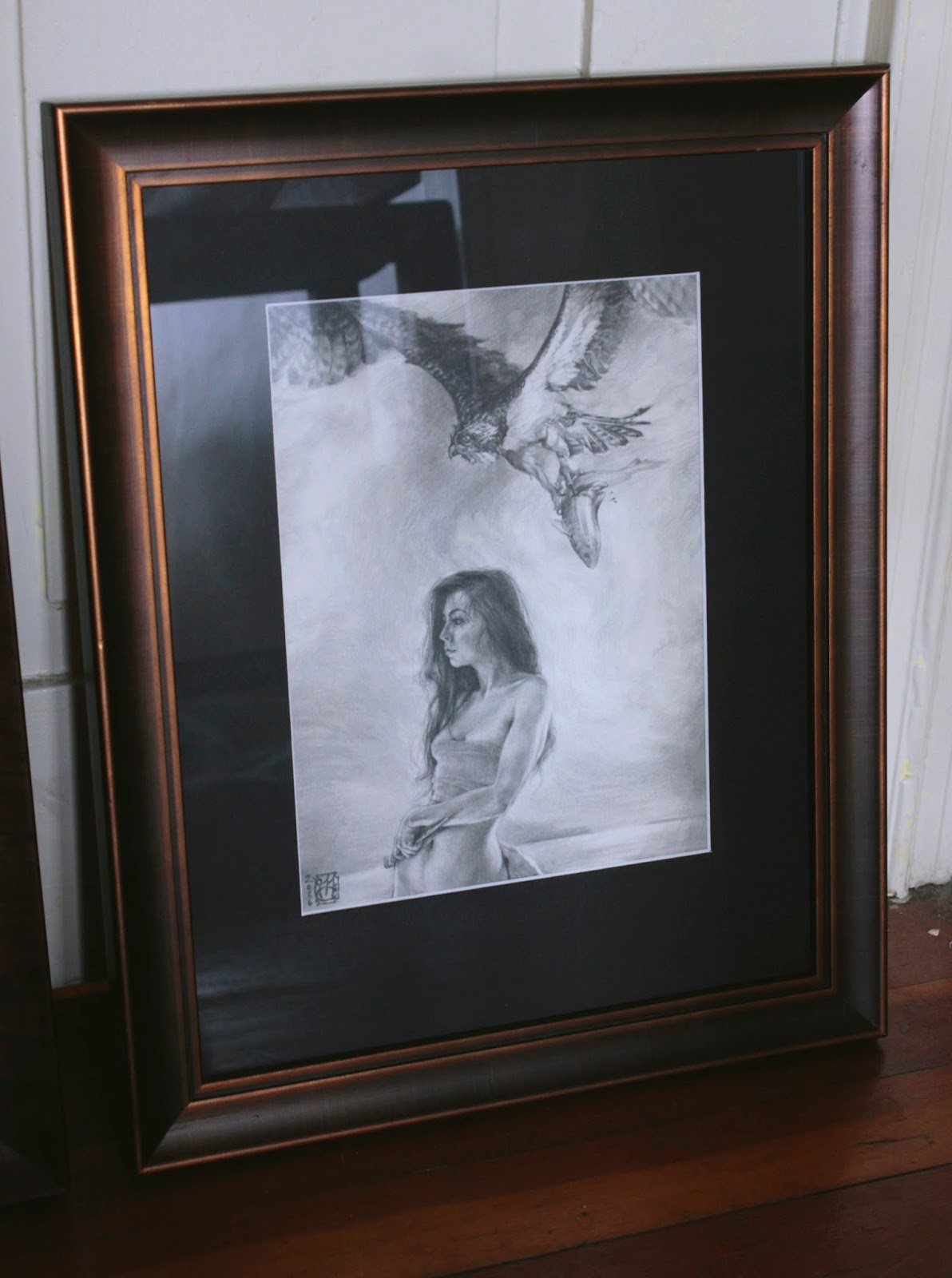
"Patience" and "Intuition"...

Concepts of value in the human psyche. Skills of perception and volition that are strengthened with time and self-discipline, or honed and refined with care, and experience.

*Scroll down for the content artist's statement

"Patience" and "Intuition", respectively, *custom framed, pre-show photo - May 2016

My notable colleague Evan Kitson curated this show called "Beyond the Surface: A Survey of Contemporary Drawing", bringing together the drawn work of artists from the East Coast metropolitan area.

I knew these two concepts that I had been long wanting to put to paper would be the ones I would contribute to the exhibition.

The concepts are near and dear to me, for philosophical and personal reasons. Once I had articulated the intention for each of the drawings for myself, I set to work visualizing the composition and working with a photographer friend to create the figure reference I needed, using myself and the choice model and friend for the other image.

Here's an idea:

Sample photo ref for "Patience" drapery...

 I tend to doodle out my initial composition thumbnails at true 'thumbnail' scale, about an inch or so large, in the "ideas" sketchbook I have... I get the thoughts down fast, scramble them about a bit in various iterations, then go to the best ones with full scale gusto.

And so begins the drawing - I'm not bashful about going all in, especially for a show:


I work with reference that I take myself, if I need it, and I work all by eye, I do not trace, I create my content drawing loosely, building up internal structure abstractly into cleaner, attentive, representational form.

It's easiest and most natural for me to find outer contour by the dictation of gestural and circular mass structure; in other words, the final outline of a figure, for example, becomes more accurate through first understanding the internal, underlying anatomy, as well as impression of character. Structure defines likeness.
Start from within, work your way out, and you won't have to erase so much, or get so lost along the way.


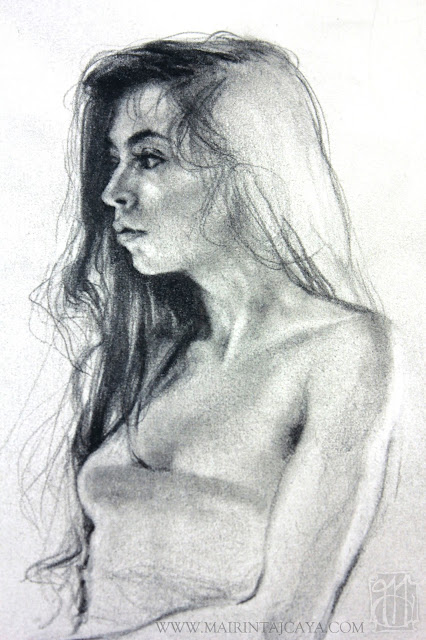


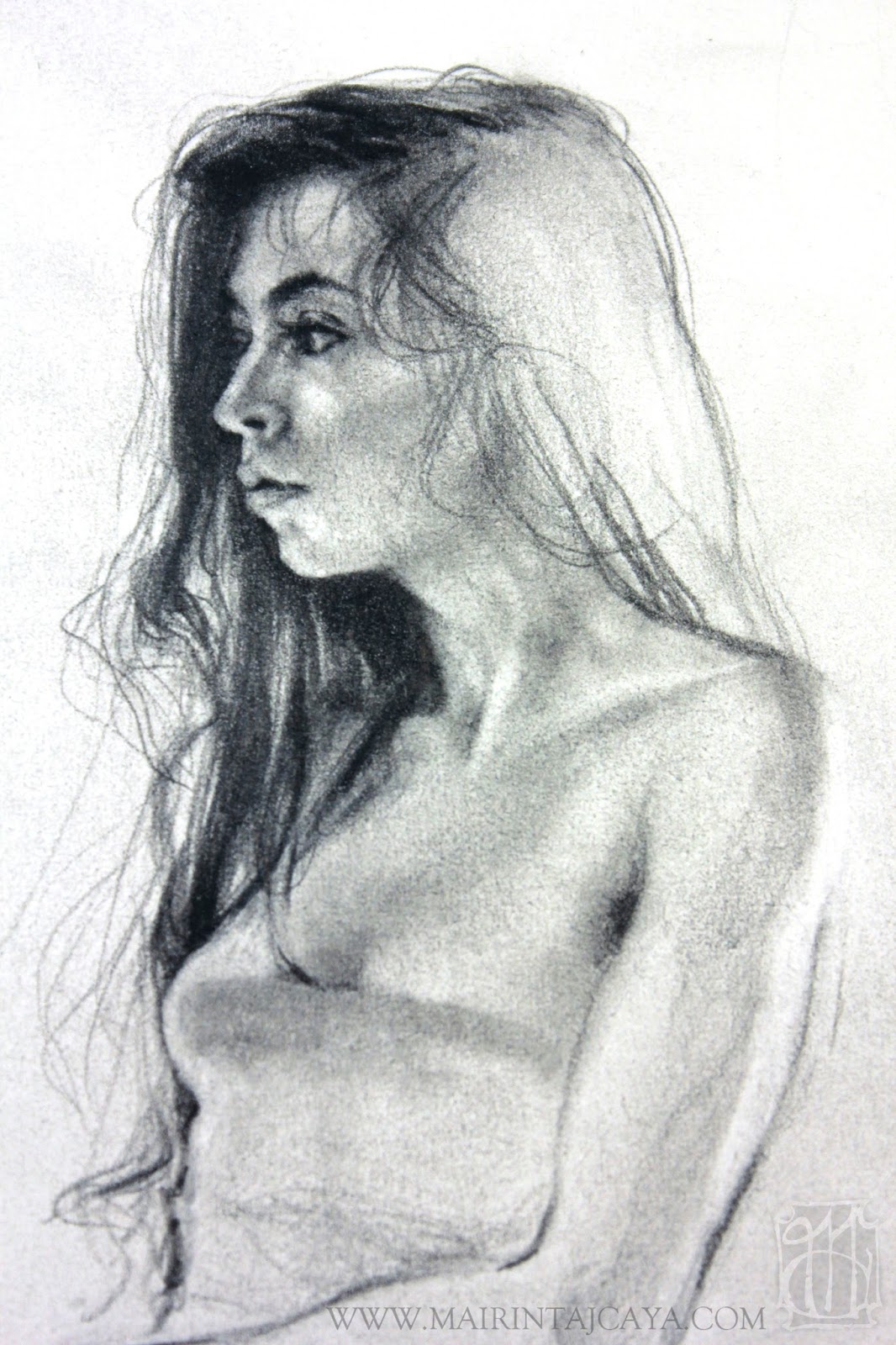
Working with your own likeness can sometimes be a bit weird, but you have to look at the process as another objective study, stepping away from personal preconceptions as much as possible and exploring what you know of yourself with your inherent insight, but leaving behind insecurities and grand projections of self-image.

I think artists naturally have more of a capacity for doing this, though, because our sort of permanent job description is to observe everything, and that means we have an inclination to try and look at ourselves more curiously than others might face themselves.
It's just a theory, but this is my experience.

I think if you're more willing to draw what you see, not what you think you see, the result will be more honest, and it will inspire more response in others.

Here, below, I am content to leave what I've sculpted out of my portrait for now, and continue developing the posture, the torso, the mass of the body, and it's lighting.

You can see down towards the pelvis and the abdominal section how I'm refining the circular structural shapes into a cohesive whole, and etching in rough sections of tone to then smooth out into a likeness of skin and shadow on skin.

That tricky hand holding the dirk, or dagger, will come later.


Below are the sweepingly loose circular structure shapes I've jotted down to get a sense of where the osprey bird will go, in relation to the figure. It's a rough impression of the inner 'wiring' of the bird's body, but that's all I need. I can refine from that, looking at my reference. And I can let little impressionistic moments from this stage linger in the final definition, to give it spontaneity and breathability.


Using an example of the process from "Patience" now, you can see the open and gestural swipes from my brush, which I used to add depth of tone and texture to the final drawing. This was a series of layers of fairly dry washes of watercolor.


I tend to geek out over simple moments, like taking the tape off the parameter of the final drawing, and seeing the stripes of natural white against tone and messy medium: #artnerd


The final art for "Patience", 7x9 1/2":

Artist's Statement:

     “Patience” is a personified illustration of the virtue and burden behind personal resolve. Calmly tenacious, centered within evergreen wisdom, there is a kindled strength to the seeming vulnerability of slow growth.


The final art for "Intuition", also 7x9 1/2":

Artist's Statement:

“Intuition” represents, in a parallel manner, the inner sage, that swift perception, a vital philosophy for free spirit and accomplishment.

     Together, the quiet volition integral to these indomitable realms partner the human icon with universal totems in their own symbolic environment.


"Intuition" has already been SOLD, through Red Raven Art Company:


"Patience" is still available for purchase, custom framed, original art:


*Fine Art Prints of "Patience" and "Intuition" are available through my website

-Mairin-Taj


30 April 2016

Life Long Study: Explaining the Imperatives of Movement and Anatomy for Artists

I’ve talked about what it’s like to be a model, and an artist, working with the nude figure before. I am often asked about the situation, and there has been plenty of confusion as well as intrigue into the stigma of the practice, so I wrote something to give a little insight into what actually happens in a figure drawing class, from both the perspective of the model, and the practicing artist, of which I am both.

*Read the post "The Naked Situation: Demystifying the Nude Model" here

But the enigmatic nature of being a visual artist - the study of nature through life-drawing, and the challenging, personal discipline demanded of an artist, for some examples - will always be a stumbling block for many.

As a professional creative, I find this confusion fascinating, baffling, and also worthy of empathy.

People love art, each in their own way, and cannot escape the visual deluge of not only our times, but of our history. Art is everywhere. For all business and entertainment. Everyone faces it, and grows their own tastes for it, subconsciously most of the time.

Besides the brief creative curriculums in contemporary western education programs, increasingly cut, that the average person is introduced to, art is taught to be a frivolity, and a poor endeavor, promising only a “starving” life. People want “security”, and expectations on luxuries to be met before they grow old, so they find a steady form of employment and distraction. If you don’t want to become an artist, if it doesn’t call to you, if you aren’t despite yourself drawing away throughout your youth, then…don’t become an artist, it’s a silly pursuit.

But, if you do want to be an artist, if you are always thinking visually and expressing yourself with this enigmatic language, well, interestingly, romance the hell out of it, and do become an artist, you wild rogue, you!

I don’t think either perspective is entirely healthy, frankly.

But here’s the point: Society now a days loves art, but hates artists, generally speaking. Or at least, they down trod on them by way of asking them to work for free, devaluing their skills and their contribution verbally or through unwillingness to pay for the thing ultimately admired and envied, and otherwise demean artists’ career conviction to be beneath other lifestyles.

Artist discipline, the various needs to be met in order to continue work as artists, is also misunderstood and consequently harassed. “The time artists devote to their work, oh!” It’s too long, it’s too intolerable, for others. “The things they do with that time! Oh, spending hours just looking at a model or a bowl of fruit and copying it?!” Or there’s the paradoxical, “I love your art, it’s pretty to look at, but spend more time with me, with people, with this, with that, and the other thing that is totally unrelated”, as if time away from working will continue to produce the prettiness people like to look at.

Such requests and complaints point to a lack of education in non-creative workers about just what is involved with being an artist, and respecting its necessarily unconventional job description as a JOB description. This is a problem, because it directly affects artists’ lives, their work efficiency, their production, and the industry, through which all others in society “enjoy art”, at the final product stage.

This problem is a symptom of educational shortcomings in culture, and of the perpetuation of pushing honest, hard workers to give up everything about their own lives save the bit about working at nothing special to them in order to have the hope of a life. It’s backwards, and the first place artists can help the massively daunting, deep-rooted cultural problem, besides sticking to their guns and continuing to create a better world, is educating those in their lives who do not understand their creative role.

Artists’ work, without an easy nine to five timetable, to become masters at what they do, to produce imagery of awe-inspiring integrity for the industry as well as the for public. For humanity. It is an honor, and a daily challenge, and a series of ever-changing choices. It is a role to manage diligently on a daily, nearly minute to minute level.

But here’s where the artist, any visual artist, begins, to maintain their position as an artist, on a humble, daily-grind scale.

Everything begins small, step by step. The demanding lifestyle of an artist is no different. Their fundamentals are practicing the basics of good drawing, which build effective visual-rendering skills, which produce good – effective – art. Work. Employment. Money. Work. 

If an artist has no sufficient time to practice, they have no product with which to earn good work, which earns good pay, which covers sustainability, health, and growth. Time IS money, to an artist. And time takes practice to manage well.

How do artists best earn through their time, then? By practicing technique and personal vision through studying nature, its motion and anatomy, its truth.

Famous, international, award-winning illustrator and concept artist John Howe articulates some of these routine imperatives in his book “Fantasy Art Workshop”:


Purchase on amazon here

Movement is part of our make-up, it is inherent in every living thing and in everything we do. Nothing is ever really still in nature, any more than time can stand still, and we have to reflect that in the drawings and paintings we make” –John Howe

Artists have to reflect that because again, it produces effective art for the industry (their livelihood), and for the public (cultural and social improvement).

Howe continues to confirm that, “movement can be arrested through an understanding of motion and anatomy”, which is how effective art is conveyed.

This is an understanding which is practiced diligently and strengthened consistently, long term; we can call it a life long study, never ceasing or dwindling in demands on one’s investment in time, energy, focus, and resources.

All of art-making requires two keystone skills; observation and decision. The practice of understanding what we see and how to mark-make in unison with our interpretation of nature – the world around us – is always a complex series of choices, one after another and in reaction to others, creating a visual picture of human experience, knowledge, and emotion. Effective art.

In order to commit to that life long study, with those ever-present demands that inevitably define improvement, both observation and decision require active practice.

And so we as artists go to figure-drawing sessions. We sit down to life-study sessions. We compose repeat still-life scenes to tediously reexamine, and we seek out more models, more costumes, more lighting stages, more scenarios of motion that will demonstrate movement and anatomy. All in order to continue the perpetual examination of nature and truth, in order to increase skill in our profession, our occupation, our passion and obsession, our life’s contribution to humanity, in order to be our very best, and isn’t that what anyone practices anything for?

Master painter and illustrator Ken Laager continues to studiously practice
his work at a collective artists' live figure drawing session in Lancaster, PA.
I've taken this behind-the-scenes picture on my break - I am the model, here.

Life-long painter, graphic designer and illustrator Petar Meseldzija explains this in his own example on improving his ability to depict horses, important to his work because the fantasy genre frequently features the animal:

“In order to understand its anatomy and movements, and to capture the right character of the animal, so powerful and gracious at the same time, I made numerous sketches and studies…Every time I come across a horse…I look at it and think: ‘how beautiful, how complex, how challenging. I have to go back to the drawing table and keep on practicing.” –Petar Meseldzija

Purchase Petar Meseldzija's book "The Legend of Steel Bashaw" here

While his sentiment is specifically about horses here, it is precisely the same with any subject, for any artist, in any genre or medium.

Artists’ life’s discipline sort of highlighting the mode of ‘professional observer’, it is after a fashion their wheelhouse and knee-jerk, constitutional state to notice and admire the myriad moments in reality that go without a second thought to most others. It’s what makes us “those weird artists” to other people.

Be it a horse, a city skyline, a sunset, a tree, a machine, a dancer, a single grape covered in dew drops, the artist looks with attentive awe and reflects: “how beautiful, how complex, how challenging; I have to go back to the drawing table and keep on practicing.”

We keep going back because practice makes perfect, and an artist is nothing if not spurred on by the prospect of the perfect work of art. This elusive falsehood is the ideal that promises better pay for our work, better network and social acceptance, better offers for more and better work, and truer satisfaction with our investment on the career we’ve devoted to like eccentric monks. Of course we’re going to keep going back, until the last breath, if necessary.

This is why wives and husbands, sweethearts, relatives, friends, enemies, all on the periphery of the artist’s discipline, perpetually see studies of who knows what baffling subject matter leafing around, on note pads, at events, in the studio, or books about odd, seemingly uninteresting subjects, or why they always have to put up with the artist committing to seemingly repetitive, gratuitous, or exclusive study sessions with other artists and…that shifty model. This is where others’ jealousy of time and attention come in to play.

But being professional observers, being driven through life and all it’s crazy dramas slightly beyond the fray, compared to other sorts of people, more in awe of those beautiful, complex, challenging horses than local gossip, artists do not enter into, work through, nor finish up any pious session of figure study, for example, with a thought any nearer the realm of ‘sex’ than a strict diet is to a gluttonous and lavish banquet.

We are professionals, for life, and to the bone, and so all movement, all anatomy, is valid, nay imperative, from an analytical and educational perspective. We may have our preferences, one artist more drawn to the human form where another is more drawn to the architectural and mechanic form, or the natural, forested world, but whatever, it is all movement and anatomy, physics and the effects of the elements on the world. This knowledge, these truths, revealed more clearly with each observation, each study session, give an artist closer achievement to excellence in their creation.

Photograph courtesy of Ken Laager, master painter and illustrator present at the studio
session for the artists' collective live figure drawing - My themed, costumed pose for the day,
for the artists subject matter.

It isn’t just for the lofty pursuit of perfection or the increased compensation that is a consequence of professional excellence – though both are good and admiral goals – but also the human connection that is improved and inspired through excellent art.

As humans, if you look at our evolution, our culture, and even the science behind strong individual cognitive development, or personal mental health, art actively matures psychological and emotional intelligence, which inherently contributes large scale to strong society, and culture.

Consider the findings of "Why Drawing Needs To Be A Curriculum Essential" written by Anita Taylor, for the Guardian:

“[Drawing] fundamentally enables the visualization and development of perceptions and ideas. With a history as long and intensive as our culture, the act of drawing remains a fundamental means to translate, document, record, and analyze the worlds we inhabit. The role of drawing in education remains critical, and not just to the creative disciplines in art and design for which it is fundamental. As a primary visual language, essential for communication and expression, drawing is as important as the development of written and verbal skills.”

Artists know this by consequence of being devotees of these principles, but it is also true gratification to their work that they may attain connection to others and inspiration for others through their work, through these principles.

Visual art is, as explained above, a use of language, and language is at the core of our humanity, because it allows us to develop and to express, through which experience, knowledge, and emotion are conducted. These things make effective art, and they make humanity evolve, grow forward, create more.

Life IS movement. And artists, visual linguists, if you will, must study life. For life.

Drawing by Ken Laager, traditional master painter and illustrator -
Copyright Ken Laager, 2016

Explore the art of Ken Laager, painter, illustrator, friend and mentor, at his official website -


-Mairin-Taj

31 January 2016

Building Up "The Safe Place" - Painting Process from Roots to Rendering

Sometimes the term 'build' is incredibly apt in describing the process through which a concept and all its integral, multifaceted parts, come together into a cohesive image.

As artists, we might more often tend to use words like "develop" or "compose" a concept, a composition, and these terms are accurate, certainly. But this painting, as well as a lot of other recent works I've been working on, have been "built" more than anything, and a large part of that has to do with the finer points in the way they were constructed, from start to finish.

This piece, "The Safe Place", was quite directly built out of the 11x14" space which it is placed in on the 400 lb. hot press Arches watercolor paper.

I designed my domain to work in, I roughly knocked out a thumbnail for guidance, I arranged my reference material, and I built this tree from the ground up, in one week, start to finish.

Here's the process, with some breakdown description, from that start to finish week:


This is what the start of any idea looks like on paper, for me. Loose and fast; shapes in value within a frame.

If you follow any of my social media posts for process, or have seen my blog before, you'll recognize this as my typical rough sketch and/or thumbnail approach.

And the following is the immediate result of choking back on the soft graphite pencil, letting the relaxed, dancerly strokes find my vision through rhythm, internal contour, and layered structure. Building it up into a state where I can go back in and start better defining the constructed forms with committed, articulate line weight variation and swatches of value definition:


Click the image for larger view

A close up of the woman's form to see a little more of the tonal detail I smudged in and carved out with an eraser.

I built up the tree as you see it above, more into the rest of the branches and roots, detailing shapes and lighting with rather abstract, calligraphic line work through tone and erasing of tone.

And then, once the drawing was certain, I stopped pushing it at that stage, in that medium, and switched over to watercolor washes to give me a sense of the color palette and how I wanted to paint it:


Simple reds and greens.

Building up:


Acrylics, matte medium, colored pencils...

And then lastly, the little details, before a final coal of matte medium, and spray UV varnish coats...Some serious drying and handling time...

Click the image for larger view

Click the image for larger view

With a custom framing job from my local art store that I am quite pleased to patron. It's great when you can support small, local businesses and receive not only solid work, but a good professional rapport.

-
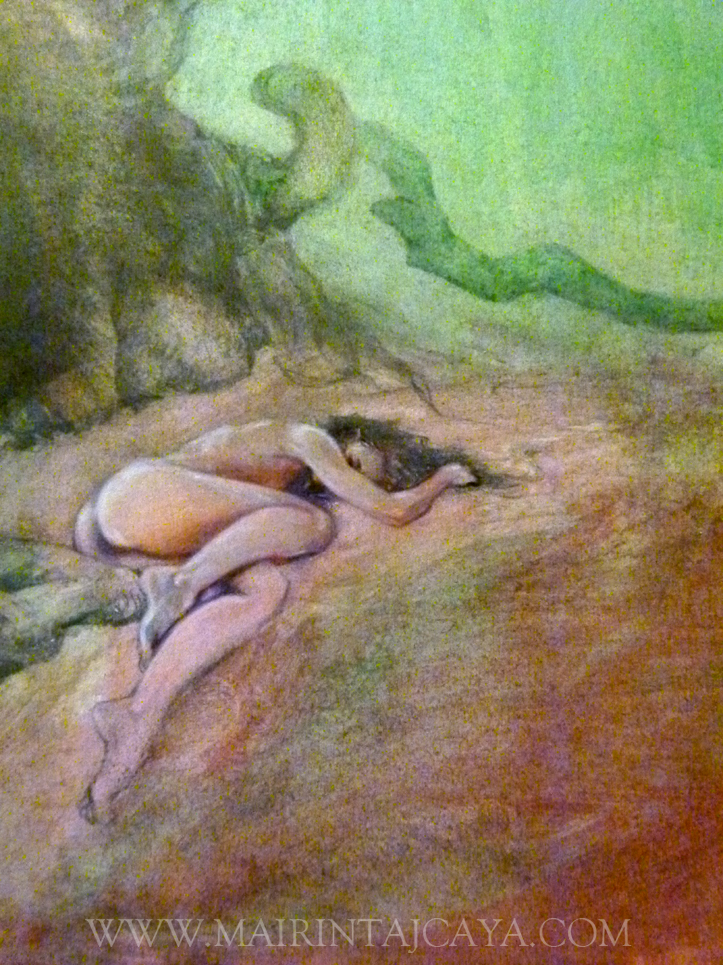
“The Safe Place” alludes to a Native American iteration of Woman as man-kind’s bridge to Nature, how she is humanity’s opportunity to cultivate a close relationship with the Wild, and how through her, the raw self runs free. Men, with their own unique value, take heed of woman’s distinctive bond to Nature in its ever-changing force. 
This piece is an interpretation of the place, the sacred space, where she might need to go to be alone, to be unburdened, uncovered, unseen by her male counterpart, and uncaught, as well. She rests, in the safe place, in the circle, at the foot at a strong, universal icon for the natural world. There is nothing else but the tree, and her.
-

"The Safe Place" is currently showing - February 5th - 28th 2016 - with two other original works of mine as part of a group exhibition showcasing local women artists in the theme of the feminine story - girls and women's empowerment, perspectives, and beauty - #ExtremeLove for #grlsgrlsgrls at The Discerning Eye Center for the Arts - the DECA Building, Lancaster, PA.

Also, art prints of the original painting are available to order HERE

For any questions or comments, contact me directly HERE


In the meantime,
Be well in this winter,

-Mairin-Taj


30 November 2015

"No Man's Land" - Allegorical Portrait from Concept to Completion

Like any concept, the initial visions of imagery and mood, message and methodology are springboard material at best; they are made of stuff that evolves, and is meant to mature as the idea is seized and formed by the artist.

I usually conceive of a few key words or phrases that represent the initial spark of the concept, and help guide the process of bringing it to roaring life.

In this case, I was working with the key word Soldier in my mind, as a I gathered additional information to then execute the concept into a final result.

Soldier evolved as it became evident that the title begged for something a bit more atmospheric in its description, as in a place, or a state of mind, more specifically. I didn't want the title "soldier" to leave the viewer stuck on the loaded iconography of what we currently think is a "soldier". I wanted the title to allude to there being more than the soldier of today, or the soldier of last century, or even the social, political archetype of the soldier figure, alone. I wanted it to be psychological. I wanted it to trigger the elusive, vaguely defined "no man's land"notion of a complex inner state, emotionally.

Perhaps this piece is an inside-out and backwards portrait of what the perspective of seeing through the psychological state of No Man's Land is like.

This final piece grew out of an exploratory study of the idea of "Soldier" I had - Again, that initial concept was a spark, but I knew it would not come to fruition through the creative process in the same form it began.

Here're some sample images of building up the first study to get more clear for myself exactly what I needed to articulate:


After the first small rough, you'll notice the final first study is quite textured, for my usual approach - I was playing and exploring, chasing something I wasn't sure of, and seeing how much I needed to push and pull the mediums to possible catch it. Here is the final:


This study was on a 6x6" loose hotpress watercolor paper sheet, trimmed with a deckled edge.

So I took a step back from getting to a point where I didn't have any other points to get to, for this particular study, and I looked at it with devil's advocate eyes, fresh intentions come readily to light for the concept's trajectory... What if I smoothed it down to push it back, going at it delicately, tenderly, instead...

I had a number of questions to answer, and once I did, I started again, this time with the final piece in mind.
Here's the way this more mature approach took form:

First, the watercolor on the natural white hot press paper! THEN, the graphite structures...


And now building likeness of my portrait first and foremost through layered form and structures, in graphite...

Loosely, generally addressing the broad shapes within the skull and flesh to create presence...

Be gentle and patient with your build up of layers and structures - Get the structures solidly, don't get lost in distraction at the final result.

The eyes are taking form, and therefore emotive impact, slowly building up.
A little gentle scumbling of layers along the negative space...
Almost there, but not quite. A good several more layers and details to go.
Matte medium and acrylic working it's way in through the layers...
I had to put some brush splatters in for the ash and other particulate...

And the final, signed piece:

"No Man's Land" - 6x6" - Mixed Media, 2015

There is elemental symbolism and primal allegory intended in the simplicity of this and similar works. I think there is much more depth, more human experience, behind the concept of "No Man's Land" than we give credit in this modern era's understanding of soldiers and war. 
This piece goes beyond the geographical battle field, and beyond physical isolation, or doubt, or displacement, though, those are in there as well.

The white feather, sent aloft, is an English symbol for cowardice. The flame is a universal aspect of life and spirit, verve, hope. It is important here that the eyes, the vision, is darkened, but still looking out. And it is important that the palette is pushed back, in an unidentifiable ash of atmosphere.

Keep the Fire. 

Contact me directly here for any inquiries on the availability of "No Man's Land", or for archival art prints of the work for purchase

-Mairin-Taj

30 October 2015

"Scrap Sneaks" - Artists' Evening Figure Drawing

I've started in with another tight little group of artists in my area for an evening live model figure drawing session, and this past Thursday, as a short break from my all day work on a Halloween-themed piece, I did this:

Model Stephanie, Reclining pose, Graphite and wash in 5x5" sketchbook, 2015

Our excellent model composed the pose herself, and our small group of four dove in to a twenty minute segments accompanied by stellar music and some pleasant banter.

Anyone familiar with Spheres by Daniel Hope? It's good stuff to draw to, I highly recommend blasting it while you work.

I intended to do a quick gesture study of the pose across the centerfold here, in the sketchbook shown above, then move on to a tighter drawing on a loose horizontal sheet of hot press watercolor paper, but I found I enjoyed the start I got with the first attempt, so I just kept along with that one. A few twenty minute segments later, time flying by, and this is what I had for the evening.

Detail, Stephanie, left, Graphite, Wash, 2015
Detail, Stephanie, right, Graphite, Wash (Fishburn...not), 2015

I actually took it home and added the wash color later.

An altogether delightful way to relax and change up the inner gears. I'm looking forward to next time!

In the meantime, back to that newly finished painting, and posting it, and continuing on that other freshly started painting...

-Mairin-Taj